It probably seems that I have a very rigid disposition when it comes to exactly how someone should animate. It might sound as if I think the way I animate is the way everyone should work or that it is the Right way to work. In actuality there is only one Wrong way to animate. There are so many different types of motion a game animator has to deal with that one workflow can't handle every situation. A good animator is adaptable, malleable and creates movement in smart ways. Smart work is what I will forever push for, sometimes at the cost of quality. In many ways game animators have to forget that they are making single, unique, special animations for themselves and are instead making a product for someone else. They're shaping an experience.
I started this blog mainly to document the way I put keys down and why, maybe just to remind myself how I should work, to keep from getting lazy, but also perhaps because I have been seeing so many demos that, quite frankly, do not cut it. Reels with too much overlap, excessive squash and stretch, unrealistic motion, stiff movement, poor action, soft hits, and bland expression are fairly commonplace among new animators. It occurred to me that a lot of folks are being taught poor habits, poor techniques, and even worse, poor direction. Upon writing all of this it also struck me that I don't actually have a demo reel. I have never had a demo reel. Hell, I don't even have 3d software at home.
I don't remember exactly who it was (probably this guy) that told me as an animator my job was "sculpting time" but initially I took that very literally. It meant I was moving characters around in a 3d program, creating motion within a framework, applying that motion to a certain amount of time, and making shit move. I think that same phrase still applies to how I go about the job now, but not necessarily in the same sense. Instead it means that the viewer, the player, is getting an experience I am helping create. Up against Milt Kahl talking about, "Where you were, where you are, and where you are going," the idea of Sculpting Time might be the second best thing I ever learned on this job.
In the past ten years I have recognized moments where I've gotten a little lazy. I want to work on big, fantastic, player driven experiences so much that sometimes the small stuff that needs to be done feels like a bore. Some tasks are so tedious that I simply do not want to throw any love their way. This could be anything from a blend set to a walk cycle but the majority of the time that I do my worst work is when I disagree with design. It's frustrating because I am the one who has to make an idea I don't like move but I also recognize that that is what comes with the job. Sometimes I'm wrong and sometimes I am proven right. It works both ways. Often the best solutions come from collaboration. In any case, everything the player experiences is actually important.
I have often dreaded the impending demise of the sense of adventure I felt as a kid playing games. I always felt an affinity towards the avatars in games as something of an escape but also as an experience. I got to Be someone else. I got to do things I couldn't do; Incredible, unbelievable things. The trepidation I have towards playing games these days has a lot to do with the rise of First Person games but also with the lack of appealing stories and characters, and subsequently, personalities. This might be due to the amount of pseudo "realism" injected into 3d games and the fact that I can no longer take away my own interpretation of their characters. Maybe they're just not good characters to begin with. Maybe I'm just a dinosaur who doesn't understand the market.
All I have ever wanted to make in this business is a recreation of the sense of adventure I got as a kid, whether watching The Goonies or playing The Legend of Zelda. As an animator the best I can do to achieve that goal is to give the viewer, the player, an experience.
Getting back to the Right and Wrong way to animate I see that not liking the idea you are working on should not be a deterrent to creating quality animation. Not giving enough care to what you are making is, in fact, the only Wrong way to animate.
Monday, October 10, 2011

Tuesday, August 9, 2011
Speed.
 According to myself and a few designers I have worked with I am a fast animator. I'm fast as all hell when it comes to making 3D animation and that doesn't mean I'm the best. It just means I'm fast. I can quickly make an animation that suits design purposes and maybe even animation purposes, but really, I'm just fast. It doesn't mean my animation is superior with regards to motion, or performance, or even action. All it means is that I can make animations very rapidly with regard to turnaround time. What takes some animators days takes me hours or perhaps minutes.
There has been a saying or a joke or what have you throughout my entire career that if a designer needs something done in a short amount of time they ask for a, "Mike Carr Special." That means I make a short animation in about ten to twenty minutes. Something simple, but also, something shippable. This happens a lot. First pass/final pass has always pervaded my workflow but speed is equally essential. Because I work in games and not film there is very little finessing that occurs and, to be fair, it probably shows.
Most of the time what I create has to do with an understanding of a designer's needs but while I work I am also considering the end of the day, the end of the project, and what I am putting my name on. I want it to look good, like most animators do, but a necessity for being fast can crush that idea.
This has a lot to do with how I've made a workflow that is superior for me and specifically, one that organizes most of the options popular software packages out there allow animators. My work setup is alien to others because I am left handed(and most people are not) and because I don't use a majority of the tools that 3D software packages offer. Still, the tools I do use are basically what anyone wanting to execute 3D animation also needs to use, all there on a little number pad with no need for complex inputs(I don't even use ctrl+z for undo anymore). What this really has to do with, however, is that I only work in key poses.
I've heard other animators say that if it looks right it is right, no matter the work flow, whether IK or FK, whether with scattered keys or organized, but that isn't the case. 3D animation is a simplification of animation principles. Key poses and automated interpolation are, at the core, why 3D is immediate. It's why 3D is so much faster and, in my opinion, generally cheaper.
Occasionally I am forced to work on another animator's file. You will never see me more upset or confused when this takes place. From what I understand, in the 2D world this rarely happens. Those scenes or shots are an animator's babies. They are nuzzled and muscled and sculpted into that singular animator's vision of what the director wants. Because it's very rare to find two animators who think exactly alike, when you have to work on another person's files there is always a period of time where you will have to reverse engineer their thinking. That little chunk of time to consider the other animator's work and thought process can sometimes eat up a lot of work hours, and can also lead to a lot of reworking animation.
Perhaps my brain is slightly more middle of the road than other artists with respect to left/right hemisphere dominance (although I doubt it) or maybe I am just a little OCD when it comes to being organized in my files. Perhaps other animators see the act of sliding keys around as part of the animation process. I can assure you, it is entirely unnecessary and contradictory to the very nature of 3D animating; It's contradictory to the nature of animation in general, to be more specific.
The idea of Persistence of Vision gave rise to more scientifically accurate theories, Phi Phenomenon and Beta Movement, both of which examine how the eye perceives a sequence of images with slight changes. These ideas are essentially the basis for why animation works. Your eyes sense change and can therefore make links between individual images to see them as moving pictures/images. If those moving images convey what is necessary to describe a movement, the movement will look correct. 3D interpolation is what this is all about. You don't have to make all those frames, you just have to push the pieces through the right poses at the right time.
I've stressed before how important keeping clean files is but I think I should repeat that sentiment. The bottom line is that 3D animation is not about shifting pieces of a character around to create motion. It's simply about key poses and letting the program do the in between work for you.
A lot of animators(I'm lookin at you, Mentor students) take the idea of squash and stretch to extremes these days, which is unfortunate. The emphasis on creating all of that overlapping, unrealistic motion will often create sloppy, disorganized keys and can, ultimately, slow a project down. Perhaps it's that the dope sheet is a much quicker way to make adjustments than the graph editor but the latter is really where adjustments to timing should be made. The in and out of a trajectory is what animators should be changing, and not the keys.
I will forever praise Valve for the sheer joy that I feel when playing Team Fortress 2(more later on that gem of a game), but the true victory of theirs lies in the character introduction pieces. Of all the, "Meet the," shorts my favorite is the Engineer's. Everything in the clip is just perfection: The offset timing of the kill counter's rotating numbers, the subtle grin he gives as the turret hits its' target, the little shift of weight when preparing to kick the dismembered arm, the left/right sway of the jaw, the voice work, the guitar playing, the fact the song is Jeff Tweedy's, "Someone Else's Song." I could go on for a while.
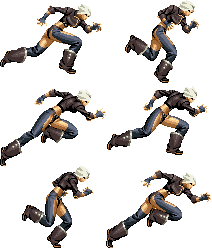
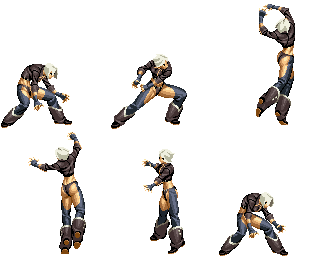
Although I can see very clearly how I would break up this animation into the parts that move at similar pacing, this scene would destroy my workflow. It is so complex and nuanced there is no way to make a file like this in clean columns, with organized spacing, and straight key posing. The left hand alone would be a sea of keys with their own unique timing. In short, when a scene calls for it, be prepared to get messy. It's hard to convey when that is called for and when it is not without a counter example, so consider this page of animations: Vanessa
 Every single one these animations could be done quickly in 3D using only key poses. They are fighting game animations, after all, which are the easiest actions to do with major poses, but even most of the in between frames would be taken care of by automated interpolation. Knowing when you need to get messy and when you need to stay organized are two huge factors in becoming a faster, cleaner, and better animator. I hope the idea catches on, because I'm kind of tired of batting cleanup.
Wednesday, July 20, 2011
Eagle Vs. Goat
Every now and then I come across an idea I absolutely do not want to work on. During God of War III it was usually something I couldn't visualize or that had no real life equivalent and therefore did not know how to start animating. Sometimes it's an idea that I feel is out of character, or something silly, or out of place in the game universe. Most of the time it's just something that is tedious to animate. Whenever I hit a roadblock I watch this video. It's absolutely incredible and instant inspiration to start thinking about how things can move in unexpected ways.
Tuesday, July 5, 2011
Puppets.
In writing these posts I've been forcing myself to really think about my workflow and mentality when I animate. Most of the time I'm not really aware of any particular plan of action that I'm taking because the tools are taking me where I need to go. The motion necessary and the restriction of time are driving me to make all my decisions on the fly.
Recently I was asked how animation has changed with the so-called "next-gen" systems and software packages game developers now have access to. My answer was probably a little short sighted but I basically said that animation, or at least the concept of it, hasn't changed much over time. The tools have improved, certainly, and there are many more techniques and ways to go about animating in both 2d and 3d than ever before. What I was trying to explain was that people still walk the same way they have walked for centuries. Motion is still motion and animation is an expression of that in an artistic medium, whether realistically or comically or abstractly. We are, for the most part, still just trying to create movement. The tools merely facilitate the same definition of animation that has always been.
In my life there's a recurring moment, be it in social circles or a bar or among family friends where I'm asked what I do. I have varying explanations for what my job entails but the easiest way I've found to say it is that I am a 3d puppeteer. It's always been apparent to me that while 3d animation uses principles of 2d animation (and more or less mimics the form) it is also very closely related to puppetry.
Ten years ago the only tools I absolutely had to use were move and rotate. I would also arrange the view to see what was going on, but really, those two tools were just about all I needed. In this way what I do really is similar to puppetry. There is a puppet(the character model) and a puppeteer(the animator) moving a puppet or a marionette in 3d space via control inputs(the rig). Move and rotate are about all a puppeteer needs, too. Puppetry, like animation, has had major improvements in tools and techniques but the general concept and definition hasn't evolved much either.
Generally 3d game animations have been performed on rather rigid skeletons with very stiff and inelastic character models. Until very recently the limitations of both 2d and 3d have left a wide gap between the benefits and drawbacks of both forms of animation. 2d has always been able to be more flexible in motion, more adaptable, and in many ways more abstract(some might also argue creative). 3d, on the other hand, allows for technical precision, speed, and immediacy. There are benefits to both and I won't argue them here.
The point I'm rambling towards is that while 2d animation made me want to do this job and 3d enabled me to make a career out of it puppetry was the first recreation of motion I was exposed to and it's still some of the most impressive, inspiring, and educational. Sesame Street was my first introduction to this art form (I'm very sad there is a possibility of it not being around anymore) and, subsequently, the Muppets.
I've posted this video before but this morning I showed it to our other animators. It really is one of the greatest clips I've come across since starting down this path. Watching it again today I also realized how it incorporates puppetry as well as 2d and 3d animation, clever editing, storytelling, smart pacing, and it's more special and enjoyable than any p.o.s summer blockbuster with transforming car ads will ever be.
Recently I was asked how animation has changed with the so-called "next-gen" systems and software packages game developers now have access to. My answer was probably a little short sighted but I basically said that animation, or at least the concept of it, hasn't changed much over time. The tools have improved, certainly, and there are many more techniques and ways to go about animating in both 2d and 3d than ever before. What I was trying to explain was that people still walk the same way they have walked for centuries. Motion is still motion and animation is an expression of that in an artistic medium, whether realistically or comically or abstractly. We are, for the most part, still just trying to create movement. The tools merely facilitate the same definition of animation that has always been.

In my life there's a recurring moment, be it in social circles or a bar or among family friends where I'm asked what I do. I have varying explanations for what my job entails but the easiest way I've found to say it is that I am a 3d puppeteer. It's always been apparent to me that while 3d animation uses principles of 2d animation (and more or less mimics the form) it is also very closely related to puppetry.
Ten years ago the only tools I absolutely had to use were move and rotate. I would also arrange the view to see what was going on, but really, those two tools were just about all I needed. In this way what I do really is similar to puppetry. There is a puppet(the character model) and a puppeteer(the animator) moving a puppet or a marionette in 3d space via control inputs(the rig). Move and rotate are about all a puppeteer needs, too. Puppetry, like animation, has had major improvements in tools and techniques but the general concept and definition hasn't evolved much either.
Generally 3d game animations have been performed on rather rigid skeletons with very stiff and inelastic character models. Until very recently the limitations of both 2d and 3d have left a wide gap between the benefits and drawbacks of both forms of animation. 2d has always been able to be more flexible in motion, more adaptable, and in many ways more abstract(some might also argue creative). 3d, on the other hand, allows for technical precision, speed, and immediacy. There are benefits to both and I won't argue them here.
The point I'm rambling towards is that while 2d animation made me want to do this job and 3d enabled me to make a career out of it puppetry was the first recreation of motion I was exposed to and it's still some of the most impressive, inspiring, and educational. Sesame Street was my first introduction to this art form (I'm very sad there is a possibility of it not being around anymore) and, subsequently, the Muppets.
I've posted this video before but this morning I showed it to our other animators. It really is one of the greatest clips I've come across since starting down this path. Watching it again today I also realized how it incorporates puppetry as well as 2d and 3d animation, clever editing, storytelling, smart pacing, and it's more special and enjoyable than any p.o.s summer blockbuster with transforming car ads will ever be.
Tuesday, June 7, 2011
Jab, Jab, Jab.
Driving home tonight I listened to an interview with Sugar Ray Leonard. He was a beast in the ring, smooth as hell, flashy, and equally as brutal. He could out punch guys 3 inches taller with a bigger reach.
Listening to him speak I remembered doing some research for the (short lived) sequel to Gun with regard to fist fights. This was the first time I ever got in a mocap suit.
Even though I could have hand-keyed a jab faster than putting on a suit, capturing the data, converting it, and then cleaning it up, we went ahead with the mocap session anyhow. For whatever reason (perhaps because I was the only animator who had ever won or even been in a fist fight) I was entrusted with doing the mocap for our new bar fight idea. I've always been a fast, hard puncher but upon seeing my own jab on a 3d character I realized that it wasn't going to work. In video games, there is a vast divide between what exists in real life and what the player experiences.
In boxing the jab is considered the most basic, fundamental punch. It is also the most versatile punch. A jab can create space, dominate action, frustrate opponents, score points, and win fights. It can be used while moving forwards to transition into combinations, or backwards to defend. It's a leading punch as well as a sufficient counter. A fast jab can change the course of a fight more efficiently than a well timed uppercut. It's also most effective when it isn't seen(The Leonard/Mayweather first round is a great example of jabs being used well). Unfortunately, a boxer's jab is not what you need when making video game combat.
During the mocap shoot I tried my damnedest to throw the fastest, cleanest jab I could(which is pretty difficult in cowboy boots). We even tried stepping in to it to give the player some forward translation for a good feel. Ultimately, what came out on our rig was a very subtle, quick, and useless jab. It was fast enough but there was hardly any motion. There wasn't a windup or a follow through or even enough time to see what was going on. Really, the only thing that moved was my left hand. It was worthless.
Boxers do exactly the opposite of what animators need to do in games. They don't throw from the hip, they throw from the shoulders, trying to give as little a tell as possible, allowing them to remain flexible as well as defensive. A jab performed well is hardly even there. It snaps out and snaps back and that's it. However, for a game animation you need tells. You need that big wind up pose. You need that follow through. You need to emulate Rocky, not Sugar Ray.
During his interview Sugar Ray also talked about how it feels when you know you've hit somebody good. How you know you've got someone done, or finished. This was another area that needed some mocap love. Hit reactions in real life occur pretty slowly. Unless you're getting knocked out people tend to have very slow reactions. In games that kind of feeling is definitely aided by camera and controller shake, but in the end, if it ain't strong enough in the animation, it ain't good enough. Make those hits count.
Since so many games rely on mocap these days I will at least admit that combat is one area where exaggeration is important. Game actions with big, comic book style posing is a huge factor in selling motion that mocap can simply not do. Unfortunately, exaggeration within games is often done during acting moments, where subtlety is key, and not during combat, where pushing poses is paramount.
Listening to him speak I remembered doing some research for the (short lived) sequel to Gun with regard to fist fights. This was the first time I ever got in a mocap suit.
Even though I could have hand-keyed a jab faster than putting on a suit, capturing the data, converting it, and then cleaning it up, we went ahead with the mocap session anyhow. For whatever reason (perhaps because I was the only animator who had ever won or even been in a fist fight) I was entrusted with doing the mocap for our new bar fight idea. I've always been a fast, hard puncher but upon seeing my own jab on a 3d character I realized that it wasn't going to work. In video games, there is a vast divide between what exists in real life and what the player experiences.
In boxing the jab is considered the most basic, fundamental punch. It is also the most versatile punch. A jab can create space, dominate action, frustrate opponents, score points, and win fights. It can be used while moving forwards to transition into combinations, or backwards to defend. It's a leading punch as well as a sufficient counter. A fast jab can change the course of a fight more efficiently than a well timed uppercut. It's also most effective when it isn't seen(The Leonard/Mayweather first round is a great example of jabs being used well). Unfortunately, a boxer's jab is not what you need when making video game combat.
During the mocap shoot I tried my damnedest to throw the fastest, cleanest jab I could(which is pretty difficult in cowboy boots). We even tried stepping in to it to give the player some forward translation for a good feel. Ultimately, what came out on our rig was a very subtle, quick, and useless jab. It was fast enough but there was hardly any motion. There wasn't a windup or a follow through or even enough time to see what was going on. Really, the only thing that moved was my left hand. It was worthless.
Boxers do exactly the opposite of what animators need to do in games. They don't throw from the hip, they throw from the shoulders, trying to give as little a tell as possible, allowing them to remain flexible as well as defensive. A jab performed well is hardly even there. It snaps out and snaps back and that's it. However, for a game animation you need tells. You need that big wind up pose. You need that follow through. You need to emulate Rocky, not Sugar Ray.
During his interview Sugar Ray also talked about how it feels when you know you've hit somebody good. How you know you've got someone done, or finished. This was another area that needed some mocap love. Hit reactions in real life occur pretty slowly. Unless you're getting knocked out people tend to have very slow reactions. In games that kind of feeling is definitely aided by camera and controller shake, but in the end, if it ain't strong enough in the animation, it ain't good enough. Make those hits count.
Since so many games rely on mocap these days I will at least admit that combat is one area where exaggeration is important. Game actions with big, comic book style posing is a huge factor in selling motion that mocap can simply not do. Unfortunately, exaggeration within games is often done during acting moments, where subtlety is key, and not during combat, where pushing poses is paramount.
Tuesday, May 31, 2011
Wednesday, May 18, 2011
No Blocking.
Since I've received some comments about my five frame rule I realize that I should have clarified that that is not the end-all-be-all animation solution, it's just how I typically work. That's not to say every animation ends up with keys spread apart every 5 frames. Sometimes I do have to make timing adjustments but the point is that doing so is much easier to do when your file and your columns are clean. If the timing works out then that's great; If it doesn't all I do is slide neat little columns around.
The other day one of our animators was referencing a file from God of War III I did for the Hermes chase. During that particular level Hermes taunts Kratos, egging him on, teasing him, and generally being a pain in the ass. Throughout the sequence this other animator and I were tasked with doing all of Hermes' animations. We protested that it could be done with about twenty animations scripted through AI but we instead went the more tedious (and time consuming) route of making unique animations across the entire level. This meant unique transitions for unique geometry, unique taunts, and unique idle animations; It was a TON of work and we had to hustle to get hundreds of animations done in a very short period of time. Luckily he and I both came from the first pass/final pass school of thought, have a similar workflow, and knocked them all out pretty quickly. They weren't our greatest animations but they worked.
The animation my friend happened to be looking at was a rather long stretch where Hermes climbs up a bridge that has fallen. He jumps and climbs and flips acrobatically throughout the whole thing. While looking at this particular animation the animator remarked, "How did you do this? I would have had twice as many keys."
(Swear I'll eventually get a video of my own for this.)
This got me to thinking about how I actually go about planning animations and I realized that most animators do a lot of blocking where I do none. In fact, I often refuse to do blocking because it's quicker for me to just "Go." I work this way because my animations are all key poses anyway(Keep in mind that I work on in-game player animations so this might not apply to a cinematic, but generally speaking I work from start to finish without turning back).
I've found that like the Animator's Animator/Designer's Animator dichotomy, there is another one in the form of Physical Actors and Mental Actors. Occasionally I will see one of our animators get up and act out a move. They will grab a fake sword or weapon and physically imitate what they are going to animate. I do this as well when I'm stumped but if there is any planning at all, it's usually done in my head. The majority of the time I allow motivation and personality to let gravity take the character where it needs to.
In the case of Hermes climbing the bridge there wasn't much forethought at all. The only thing I had to worry about was that Kratos couldn't catch up to him. This meant over a certain amount of frames Hermes had to travel upwards to a distance of x. The movements he makes all came from a necessity to travel that distance with an acrobatic flair and I let his momentum take him, varying what he was doing enough to make it interesting. In fact, if the player completes the sequence perfectly Kratos ends up right on Hermes' heels and just slightly out of reach.
Since we were working rather blindly from level design and cameras(and they from us), a good many of the "Hermes Run" animations weren't seen. This was so frustrating because the cameras could have showcased both Hermes and Kratos but that ended up not being the case. The bridge sequence was one of the few that was clearly visible. It's also an example of a five frame rule animation that had timing changes. Because Hermes was so damn fast most of his anims received a timing change. Often this was done by scaling all of the keys back but the bridge in particular needed several footfalls and hand grabs on 2s or 3s. In the end the file still came out mostly on 5s but it's obvious that most of the points of contact with the environment couldn't have been done that way.
The Hermes run was really fun to animate because there were so many different motions we got to play with, though virtually all of them, hundreds of animations, went unseen. At the time all we had to work with was rough level geometry (which sometimes changed), temporary cameras, and a predetermined destination for each transition animation. The only way we could have gotten all of those animations done was to simply, "Go."
The other day one of our animators was referencing a file from God of War III I did for the Hermes chase. During that particular level Hermes taunts Kratos, egging him on, teasing him, and generally being a pain in the ass. Throughout the sequence this other animator and I were tasked with doing all of Hermes' animations. We protested that it could be done with about twenty animations scripted through AI but we instead went the more tedious (and time consuming) route of making unique animations across the entire level. This meant unique transitions for unique geometry, unique taunts, and unique idle animations; It was a TON of work and we had to hustle to get hundreds of animations done in a very short period of time. Luckily he and I both came from the first pass/final pass school of thought, have a similar workflow, and knocked them all out pretty quickly. They weren't our greatest animations but they worked.
The animation my friend happened to be looking at was a rather long stretch where Hermes climbs up a bridge that has fallen. He jumps and climbs and flips acrobatically throughout the whole thing. While looking at this particular animation the animator remarked, "How did you do this? I would have had twice as many keys."
(Swear I'll eventually get a video of my own for this.)
This got me to thinking about how I actually go about planning animations and I realized that most animators do a lot of blocking where I do none. In fact, I often refuse to do blocking because it's quicker for me to just "Go." I work this way because my animations are all key poses anyway(Keep in mind that I work on in-game player animations so this might not apply to a cinematic, but generally speaking I work from start to finish without turning back).
I've found that like the Animator's Animator/Designer's Animator dichotomy, there is another one in the form of Physical Actors and Mental Actors. Occasionally I will see one of our animators get up and act out a move. They will grab a fake sword or weapon and physically imitate what they are going to animate. I do this as well when I'm stumped but if there is any planning at all, it's usually done in my head. The majority of the time I allow motivation and personality to let gravity take the character where it needs to.
In the case of Hermes climbing the bridge there wasn't much forethought at all. The only thing I had to worry about was that Kratos couldn't catch up to him. This meant over a certain amount of frames Hermes had to travel upwards to a distance of x. The movements he makes all came from a necessity to travel that distance with an acrobatic flair and I let his momentum take him, varying what he was doing enough to make it interesting. In fact, if the player completes the sequence perfectly Kratos ends up right on Hermes' heels and just slightly out of reach.
Since we were working rather blindly from level design and cameras(and they from us), a good many of the "Hermes Run" animations weren't seen. This was so frustrating because the cameras could have showcased both Hermes and Kratos but that ended up not being the case. The bridge sequence was one of the few that was clearly visible. It's also an example of a five frame rule animation that had timing changes. Because Hermes was so damn fast most of his anims received a timing change. Often this was done by scaling all of the keys back but the bridge in particular needed several footfalls and hand grabs on 2s or 3s. In the end the file still came out mostly on 5s but it's obvious that most of the points of contact with the environment couldn't have been done that way.
The Hermes run was really fun to animate because there were so many different motions we got to play with, though virtually all of them, hundreds of animations, went unseen. At the time all we had to work with was rough level geometry (which sometimes changed), temporary cameras, and a predetermined destination for each transition animation. The only way we could have gotten all of those animations done was to simply, "Go."
Subscribe to:
Posts (Atom)